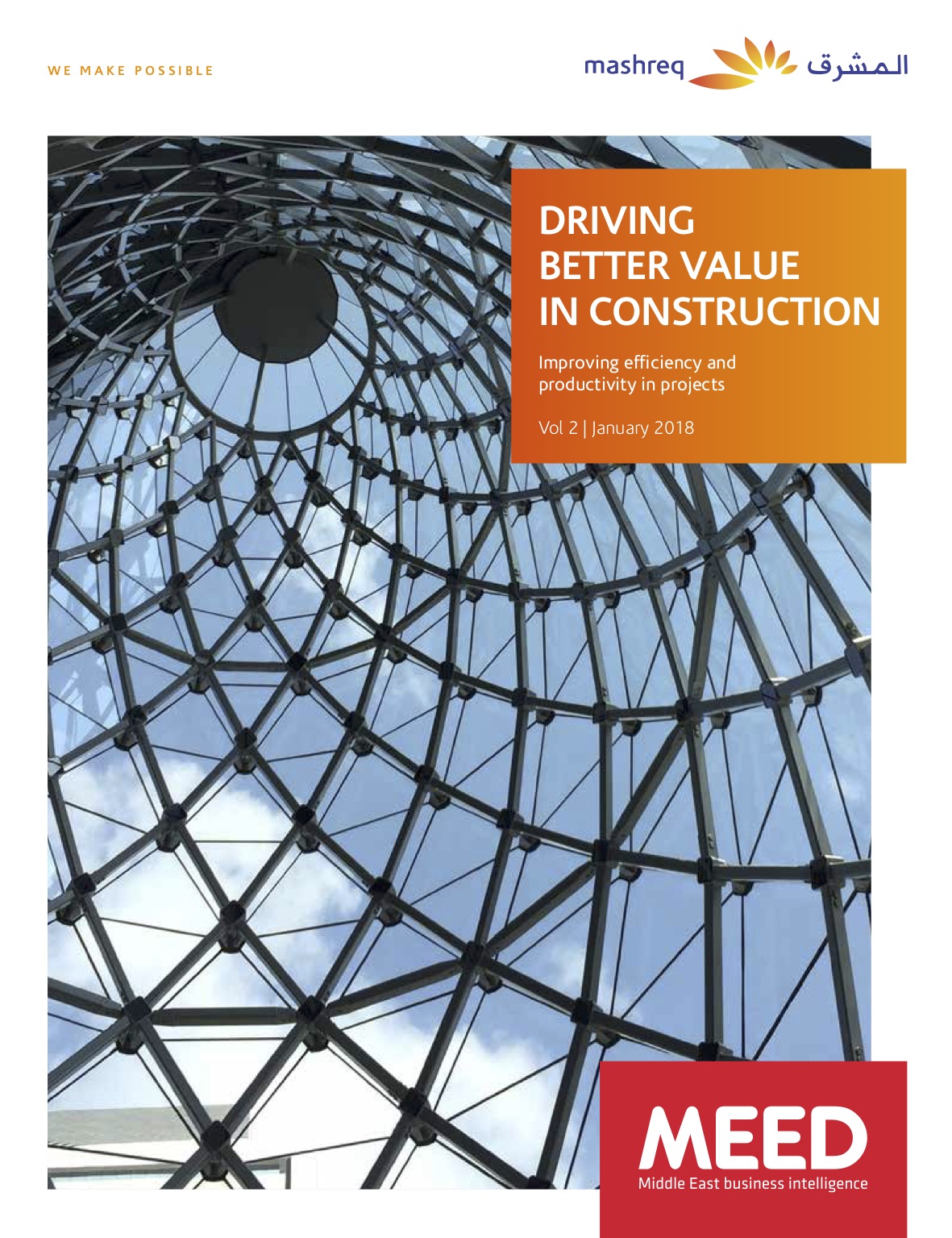
Driving better value in construction
Delivering world-class infrastructure today is essential to the success of the region tomorrow. Not only do today’s projects drive growth and create jobs, but they also lay the foundations for future prosperity and happiness.
That is why it is vital that the region’s construction industry continually strives to achieve world-class standards of quality, safety and productivity.
With more than $820bn-worth of major projects planned in the UAE, and more than $3tn across the GCC, a lot will be gained, or lost, by the way today’s projects are delivered.
This makes the construction industry strategically vital to the future of the UAE.
In order to balance their budgets, finance ministries are demanding that every dirham, riyal or dinar spent adds value to the economy. And nowhere is this more apparent than in the region’s projects sector, where vast sums have been wasted by projects that have run late and cost more than they were ever expected to cost.
But despite its strategically vital role, little has been done to improve an industry that often appears stuck in a self-destructive culture of cut-throat bidding, late payments, and adversarial contracting.
The focus, which starts with the construction clients, on getting projects built as quickly and cheaply as possible with no thought to the long-term sustainability of the project parties, undermines the sustainability of construction and projects in the UAE. It is potentially damaging the long-term prospects of the country.
Perhaps the most harmful impact is on research & development spending, where construction is lagging far behind every other industry.
But there is an opportunity to change. The digital and technological innovations that are disrupting every aspect of our lives, provide an opportunity to get rid of these damaging construction practices and to reform the way projects are delivered.
Driving better value in construction presents the findings of a wide-ranging consultation with construction industry stakeholders in the UAE, who have shared their insights on how things can and are being changed for the better.
Supported by the UAE’s ambitious Vision 2021 strategy, project teams across the country are taking their first steps towards the digitalisation of construction planning and delivery. The adoption of virtual project ‘twins’ in the cloud are forcing project teams to share information and collaborate. They are connecting every aspect of a project through its full life cycle, from concept design through to end-use. Meanwhile, technologies such as virtual reality, drones, 3D printing and generative design are all providing opportunities to rethink construction.
Utilising these new technologies requires a greater focus on quality from project clients, who must recognise that investment is needed to bring best practice into UAE projects.
While it may require higher levels of up-front capital investment, evidence shows that increasing capital expenditure to improve quality can massively reduce operation and maintenance costs throughout the life cycle of a project, and increase revenues generated from infrastructure.
We are just at the start of the process, and it requires a much greater push from all parts of the industry, but particularly from project owners and construction clients, for today’s innovations to become tomorrow’s norms.
Download the full report here